
Air Duct Cleaning: Repair or Replace? How Stapleton Homeowners Decide
Spending $500 to clean a duct system with collapsed flex runs, unsealed joints dumping conditioned air into an attic, or fiberglass liner shedding into the airstream is the HVAC version of detailing a car with a cracked engine block. Cleaning removes what’s inside. It doesn’t fix what’s broken. In Stapleton, where humid summers push flex duct harder than dry-climate installs ever face, the order of operations matters more than most homeowners realize.
Here’s the short answer: air duct cleaning comes first only when the duct system is structurally sound. When it isn’t, you repair or replace sections before cleaning. The decision comes down to three findings a technician should show you on a borescope before any work starts. If you’d rather have someone walk you through it on site, call (877) 536-7311.
Key Takeaways
- Cleaning a structurally failing duct system wastes money. Diagnose first, clean second.
- Three red flags rule out cleaning as step one: collapsed or kinked flex duct, confirmed joint separation, and deteriorated internal liner.
- A pressure test (duct blaster or manometer) quantifies leakage before anyone recommends a service path.
- Flex duct systems more than 15 to 20 years old in humid environments often degrade faster than sheet metal.
- Ask for before-and-after leakage readings and camera documentation. An honest technician will provide both.
When Is Cleaning the Wrong First Step?
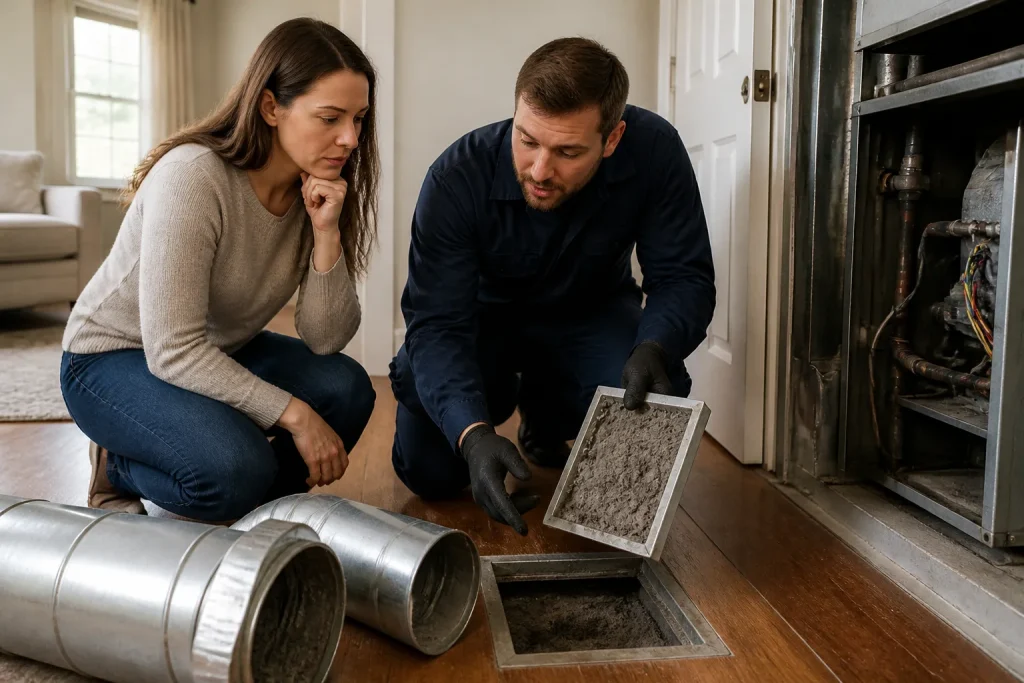
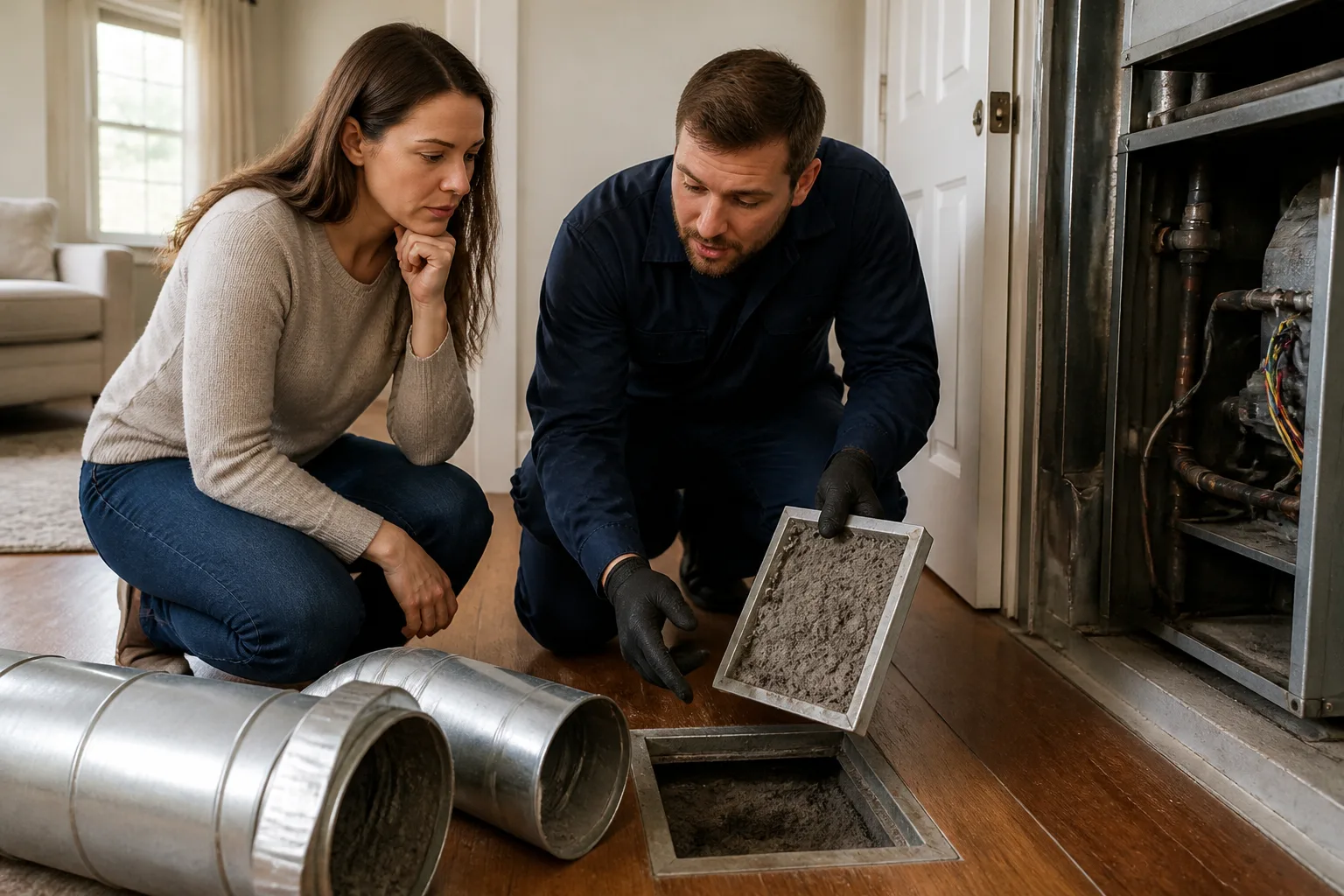
Cleaning is the wrong first step when the duct system has lost its physical integrity. Three conditions rule it out in Stapleton homes more often than any other. A professional using a borescope inspects the interior of the runs before recommending anything, and these are the findings that change the plan.
- Physical duct collapse or severe kinking in flex runs. Flex duct is corrugated and flexible by design, but sharp bends, crushed sections under flooring, or runs that have sagged over time restrict airflow and trap debris in ways cleaning can’t correct. No amount of suction restores a duct that’s been pinched closed.
- Joint separation confirmed by pressure testing. When sections have pulled apart at the collar or boot, conditioned air escapes into the attic, crawlspace, or wall cavity instead of reaching the room. Cleaning won’t rejoin those sections, and sealing over a gap without confirming the connection will just hide the problem.
- Deteriorated internal liner shedding fiberglass into the airstream. The fiberglass liner inside duct board and some insulated flex duct breaks down with age and moisture. Once it starts shedding, cleaning can actually disturb more material into the air your family breathes. That’s the point where repair or replacement takes priority.
In our experience, homeowners who’ve noticed dust buildup that returns within days or a musty smell that won’t clear are often living with one of these three conditions, not just dirty ducts.
What Does Duct Repair Actually Involve?
Duct repair means restoring the system’s seal and structure, not just wiping down the outside. The two most common approaches are mastic sealing and metal tape, and they’re not interchangeable. Mastic is a brushable sealant applied at joints, seams, and boots. It cures into a permanent bond and holds up to the temperature swings and humidity that Stapleton summers bring. Metal foil tape, properly applied, is a legitimate solution for some joints but degrades faster than mastic in humid conditions and shouldn’t be used on flex duct connections at all, where a proper saddle connection with an inner collar and mastic is the standard.
When a section is too far gone to patch – collapsed, water-damaged, or shedding liner – replacing that section is cleaner than layering a repair over a failing component. A saddle connection at the trunk and a mastic-sealed boot at the register is usually the better answer than patching a crumbling run. Our team handles repair and sealing as a standalone service and as a follow-up to cleaning, so the root cause gets addressed rather than the symptom.
What Is a Pressure Test, and Why Does It Matter Before You Decide?
A pressure test measures how much air your duct system is losing. A technician seals the registers, connects a calibrated fan (a duct blaster) to the system, and pressurizes it. The fan’s airflow reading, taken with a manometer, tells you the leakage rate in cubic feet per minute. Comparing that number to the system’s total design airflow gives you a leakage percentage. A system leaking 20 to 30 percent of its conditioned air into an attic is a repair problem, not a cleaning problem. A system leaking 5 to 10 percent and otherwise intact is a strong candidate for cleaning and light sealing.
What matters is that the reading is taken before anything is recommended and again after the work is complete. That before-and-after number is your proof that the seal actually improved, not just that a technician spent an afternoon in your attic. We use professional-grade Rotobrush and Nikro equipment for cleaning and standard duct blaster and manometer tools for pressure diagnostics, and we’ll show you the reading on both ends of the job.
How Does Duct Age Change the Decision?
Age changes the decision because duct materials degrade at different rates depending on what they’re made of and what climate they live in. Flex duct installed in Stapleton homes more than 15 to 20 years ago has typically seen enough humid summers to soften the liner, loosen the corrugation, and stress the connections at every boot. Sheet metal duct from the same era usually holds up better structurally, though its joints may need resealing. That age gap matters when you’re weighing cleaning versus replacement.
- Under 10 years, flexible or sheet metal: cleaning and light sealing are usually the right call if the system is intact.
- 10 to 15 years, flex duct: cleaning plus a pressure test and joint inspection makes sense; repair any separation found.
- 15 to 20 years, flex duct in humid conditions: replacement of degraded runs should be on the table before cleaning, especially if the liner is shedding or runs are kinked.
- 20+ years, any material: a full inspection and pressure test should come before any cleaning recommendation. Structural issues often outweigh dirt at this point.
The system may also be ready for an upgrade in filtration or air quality control. Honeywell and Aprilaire filtration products can be integrated at the same time as a repair or replacement, which is a good reason to plan for both together rather than as separate projects.
What Should You Ask a Technician Before You Decide?
Ask for the evidence before you agree to anything. A technician who’s genuinely diagnosing your system should be able to show you the condition of the duct interior, the leakage reading, and the plan for addressing what the inspection found. These are the questions that force that:
- “Can you show me the leakage reading before and after the work?” If a technician can’t produce a before-and-after number, they’re guessing at the seal’s effectiveness.
- “Will you document the problem areas on camera before we decide?” A borescope walkthrough of the interior of each run should be part of any honest recommendation.
- “Is this a cleaning problem or a structural problem?” The answer should cite specific findings, not a general impression.
- “What’s the plan if you find liner degradation or joint separation during the inspection?” A technician who’s ready for that answer is one who diagnoses before recommending.
If you’d rather not climb into the attic yourself, call (877) 536-7311 and we’ll take a look and give you the readings and findings before any work is scheduled. Our technicians have up to 12 years of experience, and our approach is to inspect first, show you what we find, then recommend the path that actually solves the problem.
How Do Cleaning, Repair, and Air Quality Fit Together?
Cleaning, repair, sealing, and air quality work fit together as one system, not as separate jobs. Cleaning removes accumulated debris from a sound system. Repair and sealing restore lost airflow and stop leaks. Filtration upgrades improve what circulates through the system afterward. When a Stapleton home needs all three, addressing them in sequence – inspect, repair or replace, seal, clean, then improve filtration – saves money compared with treating each as a separate service call. That’s why we offer the full range of services from one company: air duct cleaning, dryer vent cleaning, HVAC cleaning, repair and sealing, and air quality sanitizing with Guardsman-backed treatment options. Our work with Abatement Technologies also means contaminant control and air quality remediation are handled with the same professional-grade equipment used on commercial jobs, not a shop vacuum.
Whether you’re in this for the long term or planning a move, the order of operations is the same. It’s the one thing that doesn’t change depending on the house.
The Bottom Line
Cleaning is the right answer only for a structurally sound system. Collapsed flex runs, confirmed joint separation, and shedding liner are the three findings that make repair or replacement the first step. A pressure test gives you the numbers to prove which case you’re in. Ask for before-and-after leakage readings and camera documentation, and don’t accept a cleaning recommendation without them. If you’re in Stapleton and need help, Air Duct Cleaning Stapleton offers free estimates, call (877) 536-7311.
Frequently Asked Questions
The price is set per job by the written estimate, and it depends on the number of runs, the system’s condition, and whether repair or sealing is needed first. A sound system gets one flat price agreed before work starts, and the estimate is free. Call (877) 536-7311 for an exact quote.
Cheap quotes usually skip the diagnosis. A low price on cleaning alone makes no sense if the ducts need repair, and it makes even less sense if there’s a pressure test that should have been done first. Ask what’s included and whether the technician will show a leakage reading before and after. Call (877) 536-7311 for a free estimate that covers the whole picture.
Camera documentation is the answer. A borescope walkthrough before and after, plus before-and-after leakage numbers from a pressure test, shows exactly what changed inside the system. Ask for both. Call (877) 536-7311 and we’ll walk you through what a documented inspection looks like for your Stapleton home.
Most homes benefit from cleaning every few years, but the timing depends on pets, allergies, recent renovation, and the condition of the duct system itself. If you’ve noticed that dust or smell keeps returning quickly, get an inspection before scheduling a cleaning. Call (877) 536-7311.
If you’re in Stapleton and want a straight answer about your duct system before deciding between cleaning, repair, or replacement, call (877) 536-7311 for a free estimate. We answer 24/7. Fast dispatch from 7am to 7pm, Sunday through Friday.
Written by the team at Air Duct Cleaning Stapleton.
Need Air Duct Cleaning Help?
Call Air Duct Cleaning Stapleton - the local pro we connect you with is licensed and insured, here with fast help in Stapleton.
(877) 536-7311