
Emergency Air Duct Cleaning Near Me: What Stapleton Homeowners Should Do First
If you’ve just had sewage back up near your air handler, found a dead animal in a duct, or learned your HVAC system ran through a house fire, calling for a “cleaning” is actually the wrong first move. Most duct emergencies aren’t cleaned away right away. They’re contained first, assessed second, and cleaned third. Homeowners in Stapleton who skip that triage and rush straight to a cleaning van often spread the contamination further or pay more to fix it. Here’s the right sequence.
What Actually Counts as a Duct Emergency in Stapleton?
A true duct emergency is any event that introduces a contaminant into your ductwork that a routine cleaning can’t safely remove. In Stapleton, we see a handful of situations that qualify: rodent or animal intrusion into the ducts, smoke residue after a house fire, sewage or floodwater infiltrating the system, and confirmed mold growth inside the air handler or supply plenum. Those are emergencies because the contaminant is actively circulating every time your system runs.
A duct cleaning that merely feels urgent is different. If your allergies flared up this week, if you noticed a musty smell when the heat kicked on, or if dust is settling on the furniture faster than usual, that’s a real problem. It’s worth scheduling. It just isn’t the same category as sewage or smoke, and it shouldn’t be treated that way.
- True emergency: animal intrusion, fire or smoke event, sewage or floodwater in the system, visible mold in the plenum.
- Urgent but not emergency: sudden musty odor, visible dust plumes from registers, a sharp jump in allergy symptoms at home.
- Scheduled maintenance: routine cleaning every few years, dryer vent cleaning, filter upgrades.
One light note from our side: if the duct “emergency” is really a squirrel that got in through a loose exterior vent, that’s a wildlife problem wearing an HVAC costume. It still needs the ducts cleaned, but the vent gets fixed first or it happens again.
Step One: Shut the System Down Before You Call Anyone
Turn off your HVAC system at the thermostat before you do anything else. That single step matters more than any phone call. Once a contaminant is inside the ducts, a running system is a distribution machine. Every minute the fan runs, particles, spores, or smoke residue get pushed out of every supply register in the house, including the bedrooms where your family sleeps.
The same applies after a fire, a sewage backup, or a rodent discovery. Shut the system off, close the registers in the affected rooms if you can reach them, and leave them closed until a technician has assessed the spread.
- Set the thermostat to Off. Not to Fan. Off.
- Close the supply registers in rooms closest to the contamination.
- Don’t run a portable fan or a shop vac in the affected area; both stir particles into the air.
- Take photos of what you found before anything is moved.
- Call (877) 536-7311. We answer 24/7. Fast dispatch from 7am to 7pm, Sunday through Friday.
If the event is a sewage backup or a fire, your first call should go to your insurer or the fire department, not a duct cleaner. Documentation is everything, and it’s much easier to gather before the cleanup starts.
Step Two: Assess the Contamination Before Any Air Moves
Here’s where most rushed jobs go wrong. A vacuum running in a contaminated system without containment doesn’t clean anything. It changes the pressure in the ducts and pushes contamination into rooms it hadn’t reached yet. The assessment phase is what prevents that, and it comes before any equipment is turned on.
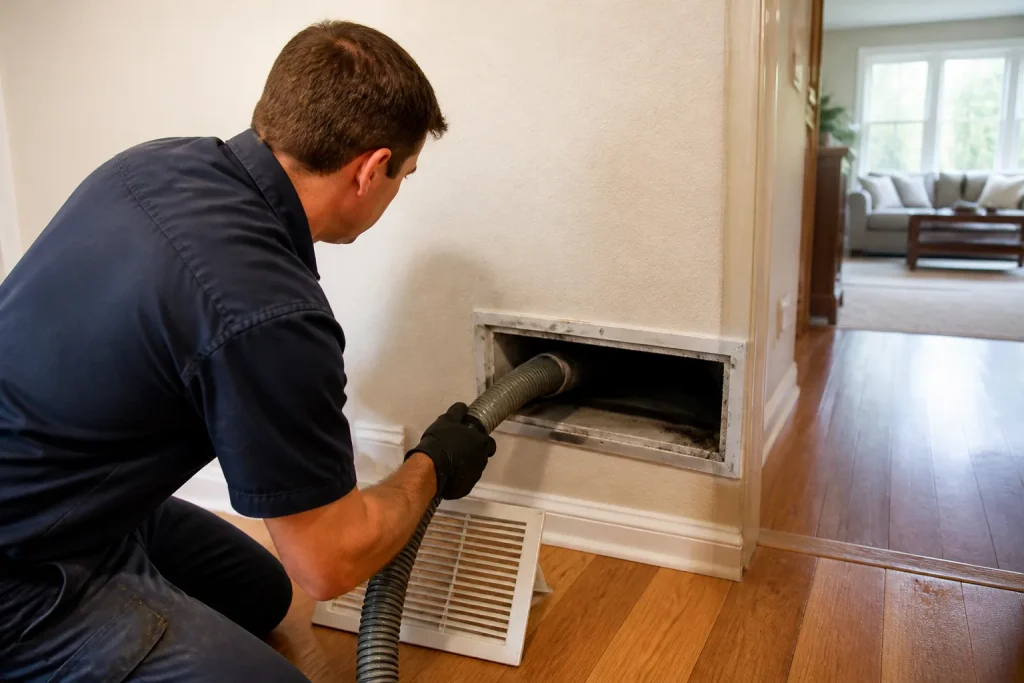
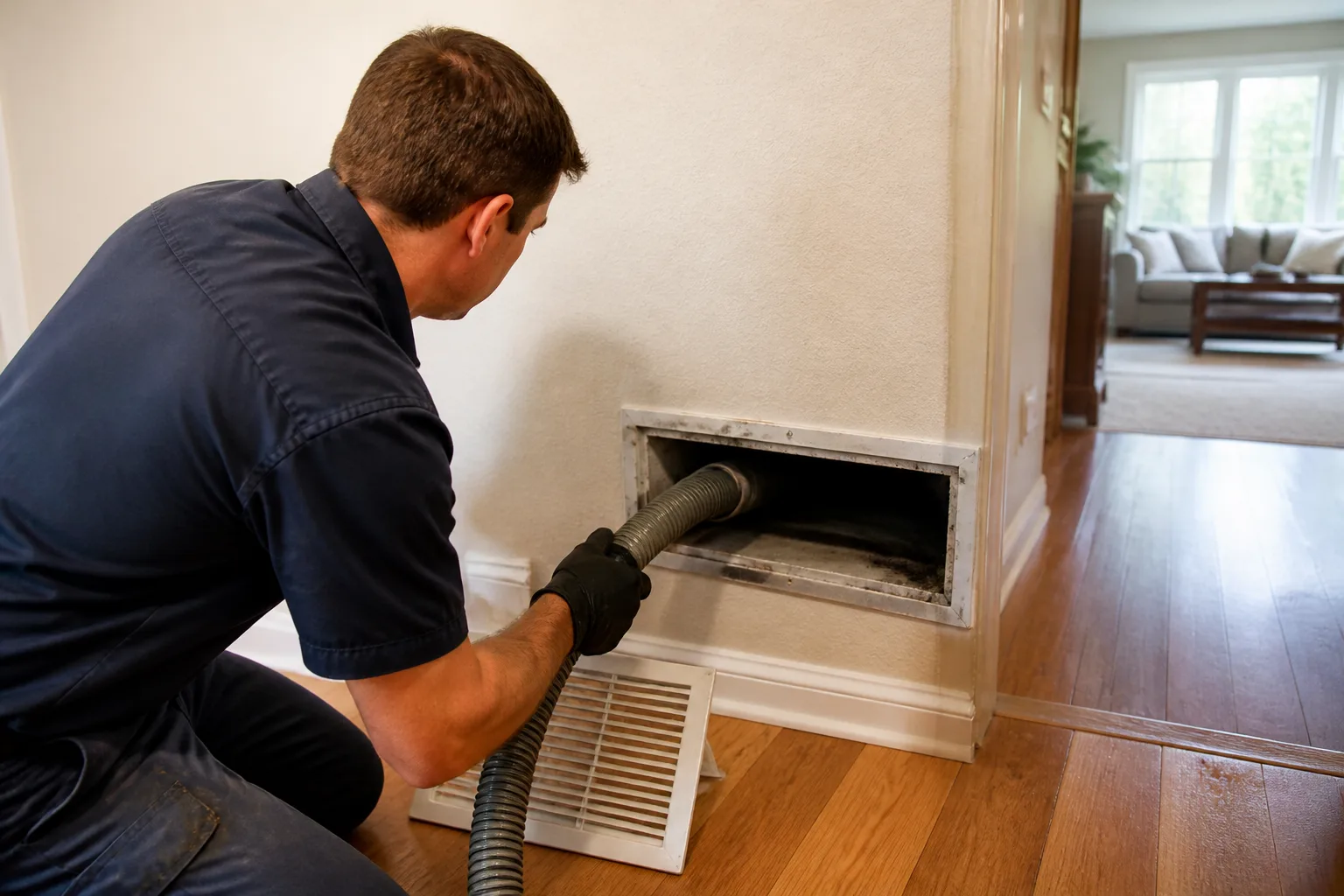
A proper assessment in a Stapleton home looks like this. A technician runs a borescope camera through the supply and return runs, the plenum, and the air handler to see what’s actually inside. They map how far the contamination has spread and identify which zones need containment. Only then does cleaning begin, and it begins with sealed containment barriers and HEPA-rated negative air equipment holding pressure in the affected zone so nothing escapes into the rest of the house.
This is why we work with Abatement Technologies equipment. It’s built for contamination control, meaning the same category of gear used when the priority is keeping particles out of the air rather than just sucking dust out of a tube. When the assessment shows mold growth or sewage residue, the cleaning sequence changes: sanitizing comes after the physical removal, not instead of it, and the affected zones stay contained until the work is done.
Technicians on our jobs have up to 12 years of experience, and most of that experience in a situation like this comes down to knowing when to stop and reassess rather than push ahead on a schedule.
Step Three: What a Legitimate Emergency Response Looks Like
The right company shows up for an emergency call with a camera and a containment plan, not just a big vacuum. Here’s what a legitimate response actually involves, so you know what to expect and what to ask for:
- Camera inspection first. A borescope goes into the ducts and plenum before any vacuum is turned on. If a company won’t show you the footage, that’s your answer.
- Containment of affected zones. Plastic sheeting and negative air pressure in the affected area, with HEPA filtration on the exhaust. This is what stops the contamination from spreading during the work.
- Documentation for your insurer. Before-and-after photos and video, a written description of what was found, and a record of the sanitizing step. We show our work in this situation specifically because adjusters ask for it.
- Correct sequencing. Remove the contaminant, clean the surfaces, then sanitize with a product suited to the contaminant. Cleaning and sanitizing are two separate steps.
If you’re comparing providers, ask two questions on the phone before you book anyone: do you carry a camera inspection unit, and do you have same-day access to HEPA-rated negative air equipment? A company that hesitates on either one isn’t set up for an emergency response. They may still be a fine option for routine air duct cleaning. They just shouldn’t be your first call when sewage is in the plenum.
What Emergency Cleaning Can’t Fix
Cleaning has limits, and a straight answer about those limits is worth more than a smooth pitch. Some contamination stays in the system no matter how good the cleaning is. Ducts that have held standing floodwater long enough to delaminate the inner liner can’t be restored by cleaning. Sewage that soaked into porous duct board or fiberglass-lined runs usually means replacement of the affected sections, not just a wash and a sanitizing pass. Extensive mold in the air handler’s insulation is a similar conversation.
Fire is its own case. Smoke residue is oily, and it travels past the ducts into the blower, the coil, and the cabinet. Cleaning the ducts alone after a fire often leaves the smell behind, which is why the work usually includes the air handler and a fresh filtration setup. Honeywell and Aprilaire media filters and IAQ components are what we recommend installing at that point, because the filter is the last line between the system and the air your family breathes. Rebooting a clean duct system through a cheap filter undoes the work in a few weeks.
And some of these problems are root causes, not cleaning jobs. Rodents get in through gaps in duct joints and unsealed seams. Dirty ducts become dirty because the system is leaking, pulling dust and attic air in at every bad joint. In Stapleton, duct access in older attic runs is where the loose connections tend to show up. We clean the system, then we fix what made it dirty. Duct repair and sealing often change a repeat emergency into scheduled maintenance. When the job runs past ductwork into the whole system, HVAC cleaning is where you start. If the problem is a clogged vent with the dryer slow to dry clothes, that’s dryer vent cleaning territory, and it’s one of the higher-priority jobs in a Stapleton home since a blocked dryer vent is a fire risk.
When to Call a Pro (and What to Ask)
If you shut the system down, walked the house, and still can’t tell how far the situation spread, that’s the moment to call. Camera inspection is the whole ballgame. You can’t fix what hasn’t been seen, and you can’t see into a plenum with a flashlight.
If you’d rather not sort this out alone, call (877) 536-7311. We answer 24/7. Fast dispatch from 7am to 7pm, Sunday through Friday. We’re closed Saturday. When you call, ask whether the dispatcher carries a camera inspection unit and has same-day access to HEPA-rated negative air equipment. Those two questions separate a response from a cleaning, and they’re the right questions whether you’re calling us or anyone else in Stapleton.
Related services in Stapleton: air duct cleaning for routine jobs, Air Duct Cleaning Stapleton for the full picture of what we handle, and the dryer vent cleaning page if the clog is on that side of the system.
The Bottom Line
Not every urgent duct problem is an emergency. Rodent intrusion, smoke damage, sewage or floodwater, and confirmed mold in the plenum are the four that deserve the word. For any of them, the sequence is the same: shut the system down, get an assessment with a camera, contain the affected zones, then clean and sanitize. Skip the triage and you may redistribute the contamination instead of removing it. Some jobs end in duct replacement rather than cleaning, and a straight answer about that early on saves you money later.
A closing thought for anyone worried about a surprise invoice: ask for one flat price per system, agreed in writing before work starts. Dirt doesn’t bill by the vent, and you shouldn’t be priced that way. If you’re in Stapleton and need help, Air Duct Cleaning Stapleton offers free estimates for the whole job. Call (877) 536-7311. We answer 24/7. Fast dispatch from 7am to 7pm, Sunday through Friday.
Frequently Asked Questions
Yes, but it’s narrower than most homeowners expect. A true emergency means a contaminant entered the ducts and is being circulated by the system: rodent intrusion, smoke from a fire, sewage or floodwater, or confirmed mold growth in the plenum. A musty smell or a spike in dust is a real problem worth scheduling, but it isn’t the same category. In either case, the first step is the same: turn the thermostat off and call (877) 536-7311. We answer 24/7. Fast dispatch from 7am to 7pm, Sunday through Friday.
Turn off the HVAC system at the thermostat and close the registers near the affected area. If the animal is dead, don’t run the system to “air it out.” The first priority is to stop the airflow so any particles or odor don’t spread through the house, then have a technician inspect the extent of the contamination with a borescope camera before any vacuum runs. Then call (877) 536-7311 for a free estimate. We can tell you what sequence makes sense for your system.
Often yes, but the ducts are rarely the whole story. Smoke residue coats the blower, the coil, and the air handler cabinet. Cleaning only the ducts can leave the smell behind. The work usually includes the full air handler, a sanitizing step, and a proper media filter such as a Honeywell or Aprilaire unit so residue doesn’t get pulled back into the supply. If cleaning is the next step for you, call (877) 536-7311 for a free estimate on the full job.
We’re closed Saturday. We’re open Sunday through Friday, 7am to 7pm, with fast dispatch from 7am to 7pm. Call (877) 536-7311. We answer 24/7, and a call outside dispatch hours is booked into the next opening, Sunday through Friday. Estimates are free, and the price you get is the price for the job, agreed in writing before any work starts.
Written by the team at Air Duct Cleaning Stapleton.
Need Air Duct Cleaning Help?
Call Air Duct Cleaning Stapleton - the local pro we connect you with is licensed and insured, here with fast help in Stapleton.
(877) 536-7311